We Design, Develop and Manufacture our Products in Silicon Valley, USA.
Niagara Networks™ delivers all the essential building blocks for high-performance visibility across physical and virtual network infrastructures. Our comprehensive portfolio includes Network Packet Brokers, Bypass Switches, Network TAPs, and a unified orchestration layer for seamless visibility and control.
Advanced Network Packet Brokers
Network Packet Broker Aggregators
Niagara Networks™ solutions enable NetOps and SecOps teams easily and efficiently operate and administer multiple security platforms and service scale, while reducing operational expenses and downtime.
Niagara Networks™ partners with world-class technology leaders to provide high performance network visibility and security.
Our partners include companies that are part of our technology alliance and companies who take part in distributing Niagara's solutions.
Expanding reach and value through a strong
worldwide network of channel partners
Empowering innovation through strategic
alliances with leading technology providers
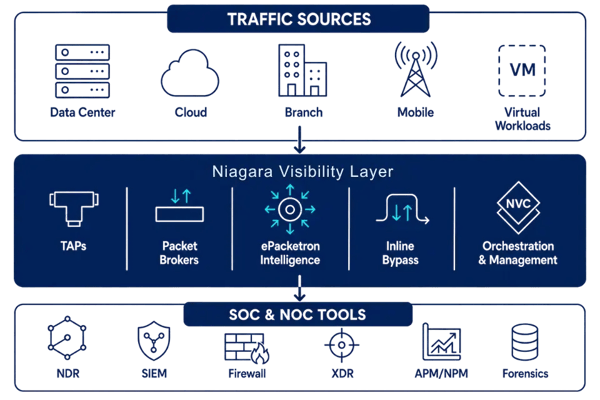
Niagara Networks turns network visibility from a collection of monitoring feeds into a managed traffic intelligence layer, capturing the right traffic, optimizing it for each tool, and protecting mission-critical networks from blind spots and downtime.
Capture complete packet data from physical, virtual, cloud, and hybrid environments using TAPs, virtual TAPs, and bypass access points.
Use packet brokers and network intelligence to filter, deduplicate, slice, decrypt, replicate, and load-balance traffic before it reaches your NOC & SOC tools.
Feed SOC, NOC, monitoring, and cyber security platforms with decrypted, reliable, policy-driven traffic while protecting uptime across mission-critical networks.
A network packet broker is the traffic engineering layer of the visibility architecture. It collects traffic from multiple access points, processes that traffic based on policy, and distributes clean, relevant streams to downstream tools.
| Function | What it does | Value Proposition - Why NetSecOps care |
|---|---|---|
| Aggregation | Combines traffic from many TAPs, SPANs, ports, and virtual sources. | Simplifies tool connectivity and creates one control point for visibility traffic. |
| Filtering | Selects traffic by port, VLAN, protocol, IP, application, or policy. | Prevents tools from wasting capacity on irrelevant traffic. |
| Deduplication | Removes duplicate packets created by overlapping visibility points. | Improves analytics accuracy and reduces unnecessary tool and storage load. |
| Packet slicing | Truncates packets to preserve headers or metadata while removing unneeded payload. | Reduces storage and tool load when full payload is not required. |
| Load balancing | Distributes traffic across multiple tools while preserving session context. | Lets teams scale inspection capacity without breaking stateful analysis. |
| Traffic intelligence | Adds decryption, metadata, application filtering, masking, NetFlow/IPFIX, and Layer 7 processing. | Turns raw packet copies into useful evidence streams for SOC and NOC workflows. |
| Use Case | Best Fit | What to emphasize |
|---|---|---|
| High-performance data center visibility | Fixed and advanced network packet brokers with high-throughput traffic processing. | Aggregate high-speed links, reduce tool overload, and deliver traffic to monitoring and security tools at scale. |
| SOC and security tool delivery | Packet brokers with filtering, replication, deduplication, TLS decryption, DPI, and load balancing. | Feed IDS, NDR, SIEM, DLP, packet capture, and forensic tools with the traffic each tool is designed to inspect. |
| Hybrid and cloud visibility | Cloud Packet Broker, Cloud Intelligence Platform, and virtual traffic access. | Extend packet-level visibility into cloud-native, virtualized, and hybrid environments where hardware cannot see traffic directly. |
| Inline security resilience | Hybrid bypass and packet broker platforms for inline security paths. | Protect production availability while routing traffic through IPS, firewall, WAF, SSL inspection, and DDoS tools. |
| Application and packet intelligence | Packetron and ePacketron acceleration for Layer 4-7 processing. | Add application awareness, metadata, masking, NetFlow/IPFIX, and SSL/TLS decryption to the visibility layer. |
Built for physical, virtual, cloud, and hybrid visibility architectures.
Designed to help SOC and NOC teams eliminate blind spots and improve tool efficiency.
Supports packet broker functions such as aggregation, filtering, deduplication, slicing, replication, and load balancing.
Pairs with Packetron and ePacketron for deeper packet intelligence, application awareness, decryption, masking, and metadata workflows
Connects naturally with Niagara TAPs, bypass switches, Cloud Intelligence Platform, Network Visibility Controller, and security-tool ecosystems.
Developed and manufactured in the USA for demanding enterprise, service provider, government, and data center environments.
1. Start with traffic sources
Map where traffic must be captured: data center fabrics, internet edges, interconnects, security zones, cloud workloads, virtual networks, OT/IoT segments, and inline inspection paths.
2. Match tools to traffic needs
Each tool should receive traffic that fits its function and capacity. IDS may need selected decrypted packets, NDR may need session context, SIEM may need metadata, and packet capture may need filtered or sliced traffic.
3. Engineer scale before tools saturate
Use filtering, deduplication, slicing, load balancing, and metadata generation before traffic reaches tools. That extends tool life and helps avoid overbuilding the security stack.
4. Plan encrypted traffic visibility
If encrypted sessions matter to security or performance workflows, design SSL/TLS decryption into the visibility layer instead of leaving every tool to solve decryption alone.
5. Include high availability for inline paths
Inline tools need bypass and failover planning. Decide which paths fail open, which fail closed, and how maintenance windows will be handled before the deployment goes live.
Will it support current links and 100G/400G growth?
Can it filter, deduplicate, slice, replicate, load balance, and steer traffic?
Can physical and cloud traffic feed the same tool stack?
Can it support bypass, HA, and inline tool protection?
Can teams manage policy centrally and automate changes?
Niagara Networks helps teams move from fragmented monitoring feeds to a unified visibility layer. Across data center, cloud, branch, mobile, and virtual environments, Niagara captures, optimizes, protects, and delivers the right traffic to SOC and NOC tools through one scalable architecture.
Compare Niagara visibility appliances and choose the right architecture for your environment Appliance Comparison Matrix
Restore encrypted traffic visibility with SSL/TLS decryption and offload advanced packet processing, including application filtering, packet slicing, deduplication, NetFlow/IPFIX, data masking, and traffic optimization. Read more
Explore Network Visibility Solutions
A network packet broker aggregates traffic from multiple network links and applies functions such as filtering, replication, deduplication, packet slicing, load balancing, application filtering, metadata generation, and SSL/TLS decryption. It then sends each security or monitoring tool only the traffic that the tool needs and can process.
A network TAP creates a reliable copy of traffic from a physical network link. A network packet broker receives traffic from TAPs, SPAN ports, virtual TAPs, cloud sources, or other access points, processes that traffic, and distributes optimized streams to multiple security and monitoring tools. TAPs provide traffic access, while packet brokers manage and optimize traffic delivery.
© 2026 Niagara Networks. All Rights Reserved.