Network visibility is becoming more and more important as organizations face the challenges of deploying increasingly complex network services such as security, performance management, and monitoring on ever-evolving and expanding networks, that span from on-prem traditional networks to hybrid cloud modern architectures. 

In an ideal world, you would cover every link to prevent blind spots in your network visibility layer. However, due to issues like budget constraints or port limitations, this may not be possible. Therefore, visibility on the high-capacity links and other critical points on your network should be prioritized. A central visibility controller management system can serve as a force multiplier on the links that you have covered.

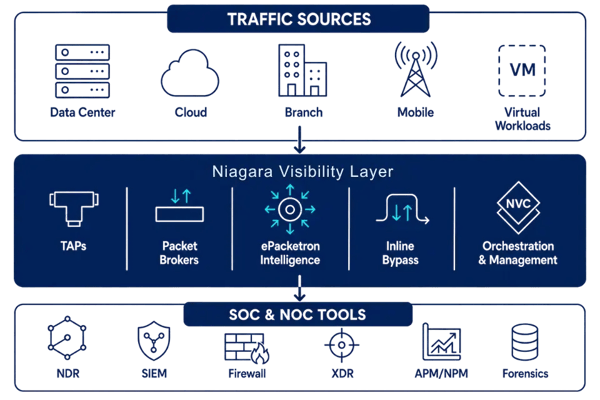
The types of network tools to empower your network visibility primarily include monitoring and inspection tools that are supported by such components as network TAPs, packet brokers (NPBs), and inline bypass switches. Each of these devices has an important function and promotes comprehensive coverage of all aspects of your network. Depending on the network architectural design – and what works best for your needs – some devices are placed in-line or out-of-band, while others are designed to specifically work out-of-band. In some cases, hybrid combinations of the devices are used that further enhance visibility.

Why Network Visibility is Critical for SecOps & NetOps?  


In modern hyper-connected environments, a "blind spot" isn't just a technical glitch - it's a massive liability. Both Security Operations (SecOps) and Network Operations (NetOps) teams require a single source of truth to maintain infrastructure integrity. Without a pervasive visibility layer, these teams are essentially "flying blind," relying on fragmented data that leads to slow response times and security vulnerabilities.

The Dual Value of Pervasive Visibility


Feature Value for SecOps Value for NetOps
Total Traffic Capture Ensures no packet goes uninspected by security tools (IDS/IPS). Provides a complete baseline for performance monitoring.
Decoupled Architecture Update security tools without taking the network offline. Enable network upgrades without breaking monitoring.
Data Optimization Filters out "noise" to focus on high-risk threats. Reduces tool oversubscription and extends hardware ROI.


Empowering SecOps: Eliminating the Shadows

For security teams, visibility is the foundation of the "Zero Trust" model. By implementing a dedicated visibility layer, SecOps can:

  • Expose Encrypted Threats: Decrypt SSL/TLS traffic centrally before it reaches inspection tools.
  • Ensure Fail-Safe Security: Use Inline Bypass switches to ensure that if a security tool fails, the network remains protected or open, based on policy
  • Strengthen Threat Hunting: Provide high-resolution metadata and PCAP data for deep forensic analysis.

Empowering NetOps: Performance Without Compromise

For network teams, visibility translates to uptime and efficiency. It allows NetOps to:

  • Drastically Reduce MTTR: Quickly identify the root cause of latency by seeing exactly where packets are dropped or delayed.
  • Load Balance Traffic: Intelligently distribute traffic across multiple monitoring tools to prevent bottlenecks during peak loads.
  • Simplify Hybrid Complexity: Gain a unified view across physical, virtual, and cloud-native environments through a single orchestration pane.


Strategic network visibility mediation layer diagram showing TAPs, Packet Brokers, and Bypass Switches.
The key to ensuring proper network visibility is creating a network visibility mediation layer that comprises strategically placed network interception TAPs, network bypasses, and intelligent packet brokers.
This kind of comprehensive visibility is called “Pervasive”.
 
A pervasive visibility layer not only increases network security, but also holds key advantages in reducing downtime in maintenance periods, improving network service recovery time, and increasing your overall ROI. If your network visibility layer is not pervasive, you risk network blind spots potentially compromising your security and network performance.
 
For pervasive network visibility, it is vital that you approach the visibility layer with a cohesive agile strategy that takes into account the current status of your network, and areas where your network and services may grow or the topology may change.