We Design, Develop and Manufacture our Products in Silicon Valley, USA.
Niagara Networks™ delivers all the essential building blocks for high-performance visibility across physical and virtual network infrastructures. Our comprehensive portfolio includes Network Packet Brokers, Bypass Switches, Network TAPs, and a unified orchestration layer for seamless visibility and control.
Advanced Network Packet Brokers
Network Packet Broker Aggregators
Niagara Networks™ solutions enable NetOps and SecOps teams easily and efficiently operate and administer multiple security platforms and service scale, while reducing operational expenses and downtime.
Niagara Networks™ partners with world-class technology leaders to provide high performance network visibility and security.
Our partners include companies that are part of our technology alliance and companies who take part in distributing Niagara's solutions.
Expanding reach and value through a strong
worldwide network of channel partners
Empowering innovation through strategic
alliances with leading technology providers
Businesses are increasingly adopting hybrid cloud environments. As these environments grow more complex, businesses need a complete view of network traffic across their entire infrastructure, including on-prem, private cloud, and public cloud. That's where cloud packet brokers come in. A cloud packet broker is a virtual networking Cloud Intelligence Platform (CIP) that aggregates, processes, and filters network packets, and ingests intelligent metadata to help you access the data that matters most, especially in cloud-native environments. Cloud packet brokers help businesses achieve hybrid cloud visibility and provide useful insights into network performance, security, and compliance across on-prem, private cloud, and public clouds.
.jpg?width=900&height=900&name=CIP%20(1).jpg)
As part of the advanced virtual packet broker service, the solution can perform advanced IPv4 and IPv6 packet parsing and manipulation from OSI Layer 2 up to Layer 7 with advanced functions like header and payload slicing, data masking, application filtering, NetFlow/IPFIX metadata generation, tunnel termination (ERSPAN, GRE, NVGRE, VXLAN, GENEVE, etc.), selective TLS decryption, mobile visibility, deduplication, packet replication, and Regular Expression filtering.
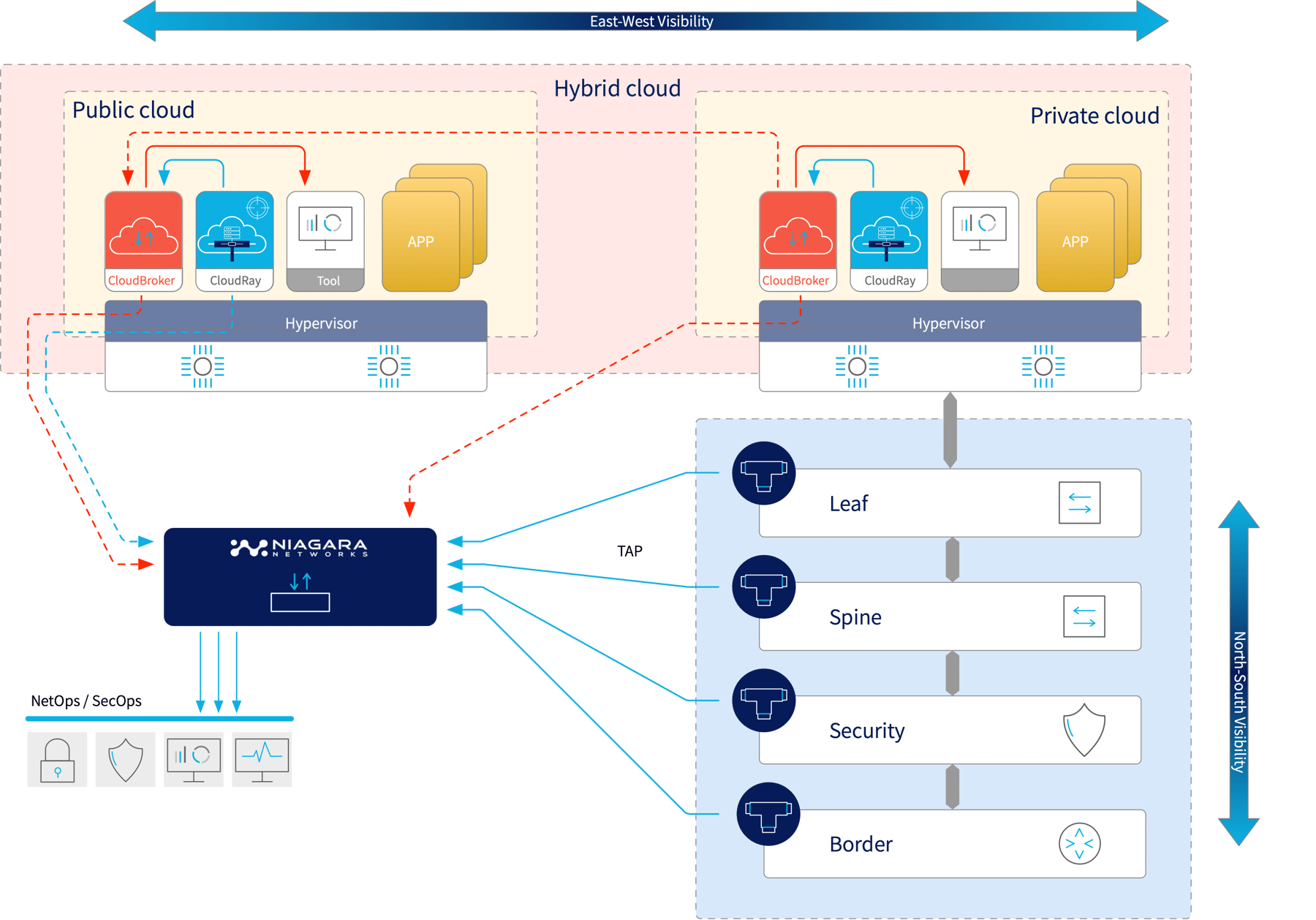
Multi-purpose solution for East-West and North-South Deployments – combining physical appliances and virtual infrastructure
SOLUTION BENEFITS
Improved network performance and cloud infrastructure observability - Niagara Networks' Cloud Packet Broker helps NetOps optimize network performance by providing real-time visibility across the digital perimeter and hybrid cloud networks. With the right data at their fingertips, IT NetOps teams can quickly find and resolve issues affecting their networks, applications, and services' performance.
Efficient cloud security - Niagara Networks Cloud Packet Broker helps SecOps secure cloud infrastructure with a comprehensive view of all traffic flowing through the hybrid cloud. With real-time visibility, SecOps can quickly detect and respond to threats, reducing the risk of data breaches and security incidents across the entire attack surface.
Regulatory Compliance - Niagara Networks Cloud Packet Broker helps CISO/CIOs meet regulatory requirements with a centralized snapshot of network activity for IT teams while streamlining complex tool stacks into coherent data visibility/compliance. With the right data and digital forensics, IT teams can demonstrate compliance with industry standards such as PCI DSS, HIPAA, CCPA, CPRA, GDPR, SOC, FISMA, FedRAMP, and others.
Support IT and cloud teams with complete, cloud-native visibility - Niagara Networks’ Cloud Intelligence TAP (CIT), our virtual TAP solution, delivers full insight into East-West, inter-VM, and cloud-native traffic by operating directly inside virtual workloads across VMware, private clouds, and public cloud platforms such as AWS, Azure, and GCP. CIT scales with workloads as they start, stop, or migrate. Combined with the Cloud Intelligence Platform (CIP) virtual packet broker, organizations gain unified, end-to-end visibility across hybrid and multi-cloud environments. CIT makes sure of efficient packet capture at the source, while CIP intelligently aggregates, filters, optimizes, and distributes it to monitoring and security tools. Together, they eliminate blind spots, streamline operations, and improve threat detection and performance across all system architectures.
|
Feature |
Technical Benefit |
Business Outcome |
|
Traffic Deduplication |
Removes redundant packets |
Reduces tool costs & cloud egress fees |
|
Packet Slicing |
Truncates payloads |
Maximizes processing speed & bandwidth |
|
Data Masking |
Obscures PII/Sensitive data |
Ensures PCI-DSS & GDPR Compliance |
|
TLS/SSL Decryption |
Inspects encrypted flows |
Eliminates security blind spots |

The cloud packet broker can be deployed on-premises or in the cloud to provide visibility, scalability, and adaptability, with an open API and a streamlined onboarding process.
It collects network packets and flow data from various virtualized sources while managing ingress and egress traffic.
Distributes packets to various endpoints, such as Security Operations Centers (SOCs), dashboards, security tools, and cloud performance management tools
Provides flexible visibility across VPC regions with consistent, stringent SLAs.
Scales with cloud consumption to support growing data traffic and data lakes.
Virtual Packetron provides packet intelligence and improved packet processing from the data layer up to the application layer. It offers an overview of system health, traffic, and monitoring status, letting you view all VPB deployments across public clouds from a single console.
Niagara Networks’ Cloud Intelligence Platform (CIP) integrates advanced features so that monitoring, security, and performance tools always receive clean, accurate, and actionable data. Here are a few of the main features:
Traffic Deduplication
Cloud environments often capture the same packets at multiple collection points, which can overwhelm multiple tools with duplicates. CIP automatically eliminates redundant packets so that only unique traffic is processed. This improves tool performance, reduces resource consumption, and lowers costs.
Packet Slicing
A cloud environment can sometimes create an enormous bandwidth problem for monitoring and securing devices. Through packet slicing, CIP makes it possible to keep necessary packet content, including headers and metadata, while getting rid of unwanted packet data. This is useful in reducing bandwidth, making the process faster, and minimizing storage space with no compromise to either visibility or compliance.
Data Masking & Privacy Controls
Sensitive data and information like user IDs, financial services data, and personal records require special treatment because of privacy protection concerns. In this regard, CIP uses data masking to mask sensitive data before traffic reaches monitoring systems, making sure that there is compliance with data protection regulations globally (GDPR, PCI-DSS, HIPAA).
Regex-Based Filtering
CIP traffic filtering filters traffic based on regular expressions and allows fine-grained control over the traffic that is filtered by security devices. This process produces less noise and fewer unnecessary traffic types that could distract the security devices. Regular expression traffic filtering is very helpful for finding specific patterns or anomalies or data required for compliance.
Tunnel Decapsulation & Multi-Layer Awareness
Contemporary cloud services use layers of encapsulation (VXLAN, GRE, GTP, and IP-in-IP). CIP finds, decrypts, and normalizes all the tunneling. As a result, multi-layer visibility allows security and monitoring tools to see the real traffic inside these tunnels, helping to improve accuracy in environments with distributed microservices, container architectures, or mobile-core tunnels.
Header Stripping for Tunnel & Overlay Simplification
Top-level cloud and virtualized networks depend largely on encapsulation methods like VLAN, QinQ, VNTag, MPLS, PPPOE, FabricPath, GTP, and ERSPAN. Headers such as these conceal the structure of the packet, causing problems with its interpretation by monitoring and security tools.
CIP allows intelligent header stripping to take away any redundant encapsulation headers and keep only the essential data and metadata. The outcome is normalized packets for downstream tools, improved interoperability, better analytics, and improved processing efficiency. Header stripping is also good for environments with mixed overlays or complex tunneling, where consistent packet formats matter for monitoring and threat detection.
NetFlow/IPFIX Generation
CIP changes raw packet streams into NetFlow/IPFIX data, providing light and scalable flow visibility without the need to forward complete packets. It lowers bandwidth needs for collection systems and is useful for long-term traffic analysis, behavior baseline, and capacity planning, particularly in large cloud or hybrid environments.
TLS/SSL Decryption*
A potential and growing blind spot for monitoring and security tools is encrypted cloud traffic. CIP offers TLS/SSL decryption, allowing decrypted flows for identification of threats, application classification, and policy enforcement. You can selectively apply TLS/SSL decryption to preserve privacy and obtain valuable insights at the same time.
Multi-Cloud Ingestion & Unified Aggregation
CIP can support traffic from any cloud, including those that feature AWS VPC Traffic Mirroring, Google Cloud Packet Mirroring, Azure vTAP, Span Ports, and 3rd Party Virtual TAPs. Traffic from all these sources merges into one common visibility layer, simplifying operations and allowing consistent monitoring over distributed infrastructures, on-prem, public cloud, private cloud, or hybrid.
GTP Correlation
For mobile networks, such as GPRS, LTE, and 5G, subscriber sessions take place through many tunnels and packets. CIP is able to perform correlation to track and link all sessions. It also helps analysis and security tools obtain a free and coherent flow of user data. This is particularly helpful for troubleshooting, billing accuracy, and security monitoring.
Deep Packet Inspection (DPI)
Beyond headers, CIP’s DPI features analyze packet payloads to identify applications, protocols, and metadata. This helps mobile service provider networks monitor applications, enforce compliance, and strengthen security by detecting anomalies in encrypted or application-specific traffic.
Load Balancing
High-traffic cloud environments demand elastic solutions. CIP intelligently distributes traffic across multiple monitoring and security tools, prevents tool overload, and delivers consistent performance. This load balancing also allows seamless scalability as demand grows.
Together, these features create a comprehensive visibility framework that helps providers adapt to cloud complexities while delivering quality service and user experience.

© 2026 Niagara Networks. All Rights Reserved.