close
close-x

Site Search

    Decrypt Once. Analyze Everywhere.

    SSL/TLS Decryption for Complete Traffic Visibility

    Encryption protects users, applications, and sensitive data. It also hides threats from the tools responsible for detecting malware, command-and-control traffic, data exfiltration, policy violations, and performance issues.
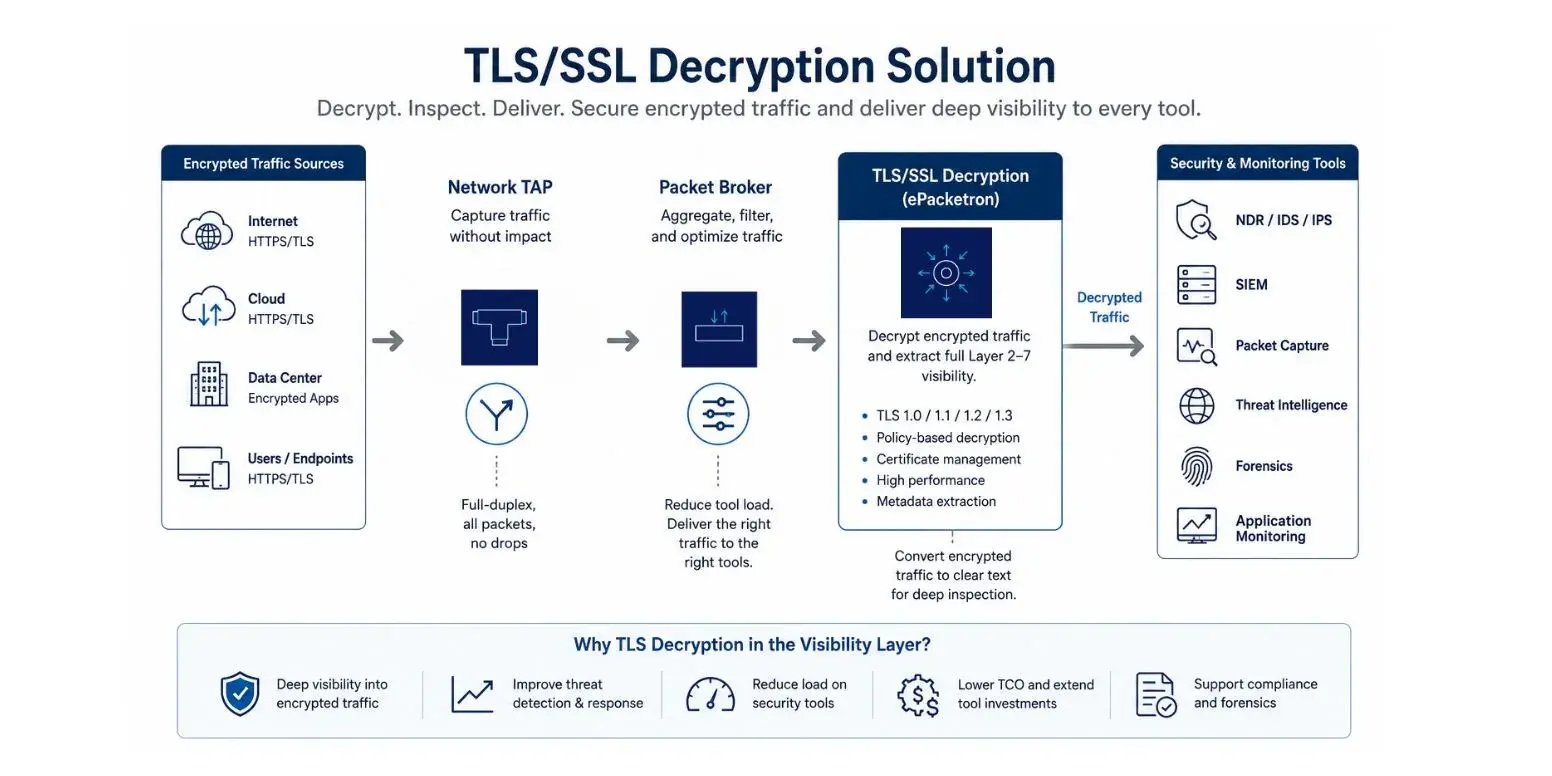
    Niagara Networks gives SOC and NOC teams a centralized SSL/TLS decryption layer inside the visibility architecture. Niagara packet brokers, Packetron intelligence, ePacketron scale-out processing, and policy-based traffic delivery help organizations decrypt approved traffic once, inspect it with the right tools, and avoid forcing every downstream appliance to perform its own decryption.
    The result is practical encrypted traffic visibility: less tool overload, fewer blind spots, and cleaner packet and metadata streams for security, monitoring, compliance, and forensic workflows.

    TLS Decryption Solution-1


    Centralized

    Centralized TLS decryption solution that restores visibility into TLS 1.2 and TLS 1.3 traffic, including environments protected by Perfect Forward Secrecy (PFS).

    Intelligence

    Enables active inline TLS/SSL decryption using a high-performance visibility architecture that combines advanced packet broker functions with ePacketron Layer 7 intelligence.

    Deliver It with Confidence

    Feed SOC, NOC, monitoring, and cyber security platforms with decrypted, reliable, policy-driven traffic while protecting uptime across mission-critical networks.

    Why SSL/TLS Decryption Belongs in the Visibility Layer

    Most modern enterprise traffic is encrypted. That means IDS, NDR, DLP, packet capture, malware analysis, and performance tools can miss important application context unless encrypted sessions are decrypted where policy allows.

    > Threats can hide inside common HTTPS sessions that look legitimate from the outside.

    > TLS 1.3 and Perfect Forward Secrecy can reduce what passive inspection tools can infer from headers alone.

    > Each tool performing its own decryption increases cost, latency, certificate management work, and operational risk.

    > Sending all decrypted traffic everywhere can create privacy, compliance, and tool-capacity problems.

    > A centralized visibility layer can decrypt once, apply policy, and distribute only the traffic each tool needs.


    Niagara Networks SSL/TLS Decryption Architecture

    Niagara Networks' architecture should be presented as a secure traffic processing workflow rather than a standalone decryption box. Traffic is captured through TAPs, packet broker ports, inline paths, or virtual/cloud visibility points. Packetron or ePacketron performs high-performance packet intelligence and decryption functions. The network packet broker then filters, masks, replicates, and load balances the resulting traffic to approved security and monitoring tools.


    Layer Niagara Networks Capabilities Value Proposition
    Blind Spots Traffic access Network TAPs, packet broker ports, virtual TAPs, and inline paths.
    Decryption engine Packetron and ePacketron provide Layer 7 traffic intelligence and decryption workflows. Offloads compute-heavy decryption from downstream tools and keeps inspection centralized.
    Policy control Filtering, masking, grooming, and traffic selection before distribution. Controls which decrypted sessions reach which tools, reducing privacy exposure and tool noise.
    Tool delivery Replication, load balancing, deduplication, packet slicing, and metadata generation. Feeds IDS, NDR, SIEM, packet capture, forensics, DLP, and analytics tools with usable traffic.
    High availability Bypass and hybrid bypass options for inline inspection paths. Supports fail-open or fail-closed policy so decryption and inspection do not become a single point of failure.

    Choose the Right TLS Decryption Model

    Use Case Best Fit What to emphasize
    Active inline decryption Prevention and inspection workflows where traffic must be decrypted, inspected, and re-encrypted in the live path. Use for inline security controls, with bypass planning, certificate governance, and availability design.
    Passive out-of-band decryption Monitoring, threat hunting, forensics, and analytics workflows where tools inspect a copied traffic stream. Use when teams need visibility without changing the production forwarding path, subject to key and TLS policy constraints.
    Decrypt once, inspect many Environments with multiple tools that need the same decrypted traffic or metadata. Centralize decryption, then filter and distribute traffic to the right tools instead of duplicating decryption across appliances.
    Metadata-only or selective decryption Privacy-sensitive or high-volume environments where full payload inspection is not always appropriate. Use policy to decide which traffic is decrypted, masked, sliced, converted to metadata, or excluded.
    Unified operations Visibility orchestration and policy-based traffic delivery. Makes the monitoring architecture easier to operate as links, tools, and workloads change.

    Use Cases for Niagara Networks SSL/TLS Decryption

    Expose threats hidden in encrypted traffic

    Malware, phishing infrastructure, command-and-control traffic, and data exfiltration often use standard encrypted sessions. Decryption restores the packet and application context that security tools need to detect and investigate those sessions.

    Reduce load on security tools

    Decrypting once in the visibility layer avoids making every downstream tool run its own TLS processing. Packet brokers can then send each tool only the relevant decrypted traffic or metadata.

    Support compliance and forensic workflows

    Approved decryption workflows can help teams retain the evidence needed for investigations, incident response, and regulated monitoring programs while applying masking and selection policies where needed.

    Improve DPI and application intelligence

    Deep packet inspection and application-aware filtering are more useful when encrypted traffic can be inspected according to policy. Niagara can pair decryption with Packetron/ePacketron traffic intelligence.

    Protect inline inspection availability

    When TLS inspection sits in the production path, bypass and high-availability design matter. Niagara bypass options help preserve continuity during tool failure, maintenance, or power events.

    Centralized Visibility Control

    Manage visibility policies consistently across TAPs, packet brokers, bypass switches, and distributed monitoring environments.

    TLS Decryption Deployment Choices

    Decision Risk if ignored Niagara Networks' Positioning
    Inline vs. out-of-band Wrong placement can create latency, blind spots, or missed prevention workflows. Use Niagara packet brokers, Packetron/ePacketron, and bypass options to support both inspection and monitoring models.
    TLS 1.3 / PFS Passive-only workflows may not expose the needed content or metadata. Use policy-driven active or centralized decryption where approved and technically appropriate.
    Privacy exclusions Over-decryption creates legal, privacy, and operational risk. Apply filtering, masking, metadata-only workflows, and exclusion policy in the visibility layer.
    Tool capacity Every tool decrypting independently increases cost and overhead. Decrypt once, inspect many; then send each tool only the traffic it needs.
    Packet Broker Alternative Traffic aggregation, filtering, load balancing, and delivery to security and monitoring tools. Purpose-built packet broker options for enterprise, carrier, and data center visibility projects.

    Niagara Networks End-to-End Visibility Solution


    Visibility Layer


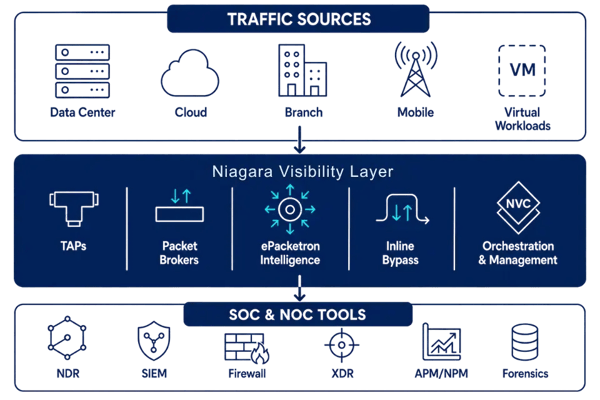
    Niagara Networks visibility portfolio helps IT teams move from fragmented monitoring feeds to a managed visibility layer. From data centers, cloud, branch, mobile, and virtual workloads, Niagara captures, optimizes, protects, and delivers traffic to SOC and NOC tools through one scalable visibility architecture. Visit Niagara Networks Appliance Comparison Matrix


    Use Niagara TAPs

    Capture traffic from critical physical links across copper, fiber, optical, passive, active, and bypass deployments. Read more

    Use Niagara Packet Brokers

    Aggregate, filter, deduplicate, replicate, and load balance traffic for multiple security and monitoring tools. Read more

    Use Niagara Hybrid TAPs and Bypass Solutions

    Protect inline security tools with failover architectures that maintain continuous traffic flow and high availability. Read more

    Use Niagara ePacketron Network Intelligence

    Restore encrypted traffic visibility with SSL/TLS decryption and offload advanced packet processing, including application filtering, packet slicing, deduplication, NetFlow/IPFIX, data masking, and traffic optimization. Read more

    Use Niagara Virtual TAPs & Virtual Packet Broker

    Extend visibility into virtualized and cloud environments, capturing east-west traffic and optimizing virtual traffic delivery where physical TAP deployment is not possible. Read more

    Use Niagara Visibility Orchestration

    Simplify provisioning and centralized policy management across the entire visibility layer. Read more
    See what encryption is hiding from your tools.

    Niagara Networks can help you design a centralized TLS decryption architecture that restores visibility, protects tool capacity, and delivers the right decrypted traffic to your SOC and NOC stack.

    Explore Network Visibility Solutions

    • Discuss packet broker, TAP, and bypass requirements
    • Review throughput, tool capacity, and deployment needs
    • Ask about pricing, availability, and product fit

    Talk to a TLS Visibility Expert